
Stimulating The Public Service, Bridging Knowledge Gaps In Benue
BY BRIDGET TIKYAA
Public servants all over the world play a crucial role in governance. They articulate, plan, execute and review government policies and programmes, and ensure successful delivery. By implementing policies, providing essential services, and ensuring the state functions effectively and transparently, they serve as the engine room of any government. Where there’s a knowledge gap in that respect, the tendency is to fail in the proper execution of vital government projects, programmes and policies.
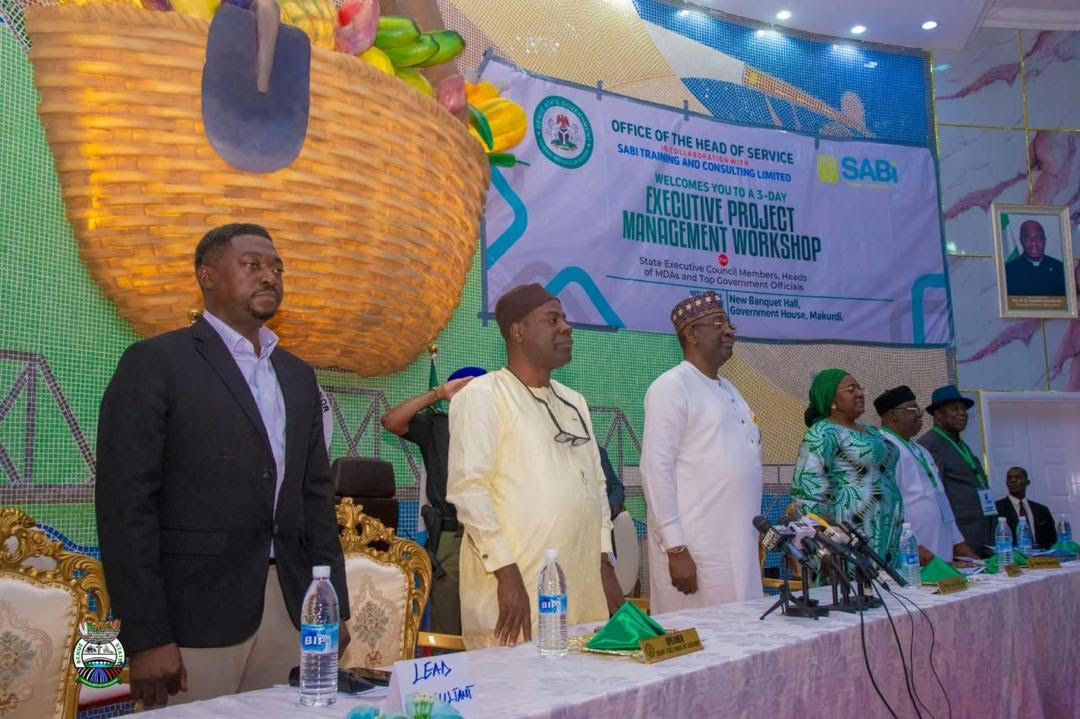
It is in this respect that the administration of Governor Hyacinth Alia of Benue State, on November 18, 2025, organised a three-day Executive Project Management Workshop for State Executive Council members, Heads of Ministries, Departments and Agencies (MDAs), legislators, and other top government functionaries.
According to the governor, represented by his Deputy, Dr. Sam Ode, the workshop is an important initiative aimed at improving the efficiency of governance, and the commitment to strengthen service delivery.
Indeed, such capacity building training helps to improve decision-making, ensure programmes and policies achieve their goals, promote transparency and accountability, and efficient use of public resources. This kind of training equips participants with the skills to collect and analyze data, understand project progress, identify areas for improvement, and ultimately demonstrate the effectiveness of their work by making it a reality for the benefit of citizens.
It also encourages learning from experience, identifying mistakes, and incorporating lessons learned into future policies and practices. Such training also strengthens the ability of public servants to oversee projects, manage budgets effectively, and ensure that public resources are used to benefit citizens.
This much was also said by the state Head of Civil Service, Dr. Moses Agbobo Ode, who said the workshop was timely and critical to addressing persistent challenges within the public sector, where many well-formulated government policies fail at the implementation stage due to weak coordination, inadequate planning tools, and insufficient risk management.
“This training has been designed to address those gaps and equip our senior officers with modern skills for effective project delivery,” he stated.
Dr. Ode said Governor Alia’s prioritisation of capacity development is a commitment to ensuring that every public expenditure translates into tangible outcomes for citizens.
This is necessary, because commissioners, permanent secretaries, and directors are the custodians of the administrative machinery, holding key responsibilities in ensuring that government policies and projects are executed within time and based on budgetary frameworks.
For the Director-General, Benue State Planning Commission, Mr Jerome Andohol, the global shift from zero-based budgeting to program-based budgeting has increased the need for public institutions to adopt strategic and results-oriented planning.
“What we are doing here is hunting for knowledge. The knowledge gained will help sustain and improve the effectiveness of our MDAs,” he said. Andohol revealed that the Planning Commission has already applied the Medium-Term Sector Strategy (MTSS) in four sectors, education, health, social protection, and WASH (Water, Sanitation and Hygiene), with plans to expand to additional sectors. He urged participants to apply the lessons learned to drive the governor’s seven-point agenda and strengthen institutional foundations.
The Secretary to the State Government, Deaconess Sermun Deborah Abeh, said the workshop aligns with the Alia administration’s vision for disciplined planning, responsible governance, and results-driven service delivery.
It is a fact that no development vision can succeed without a competent and coordinated public service. “This training will expose our senior officers to structured project management methodologies aligned with global best practices,” she said.
She stressed the importance of accurate data, clear roles, defined reporting channels, and strong inter-departmental collaboration in ensuring project success. She further urged both political appointees and civil servants to work in unity: “We must think one Benue.”
Introducing the objectives of the workshop, the Lead Consultant from SABI Training and Consulting Limited, Mr. Terver Keugh, said the programme is anchored on the globally recognized Project Management for Development methodology. He noted that many government projects fail not due to a lack of vision but because of gaps in planning, monitoring, risk management, and closure.
“Our goal is to equip participants with practical tools to ensure that government projects deliver measurable results,” he said. He explained that the three-day session will cover core areas such as project definitions, risk identification, conditions for project success, and change management, particularly when plans shift due to resource constraints or unexpected challenges.
Keugh described the workshop as a strategic investment in the execution of the Benue Development Plan and the governor’s seven-point agenda, aimed at strengthening coordination, reinforcing accountability, and enhancing development outcomes that directly impact citizens.
The workshop continues until November 20, 2025, with participants expected to engage in intensive sessions on planning, monitoring, evaluation, reporting, and adaptive project management.
Bridget Tikyaa is the Principal Special Assistant to the Governor on Media Publicity and Communications Strategy



Related to this topic:

BPP, ICAN Sign MoU to Boost Transparency in Public Procurement
23 February 2026
NCDC Flags Logistics, Data Gaps Hindering Lassa Fever Response
23 February 2026