
US Airstrikes Target Islamic State Cells in Nigeria
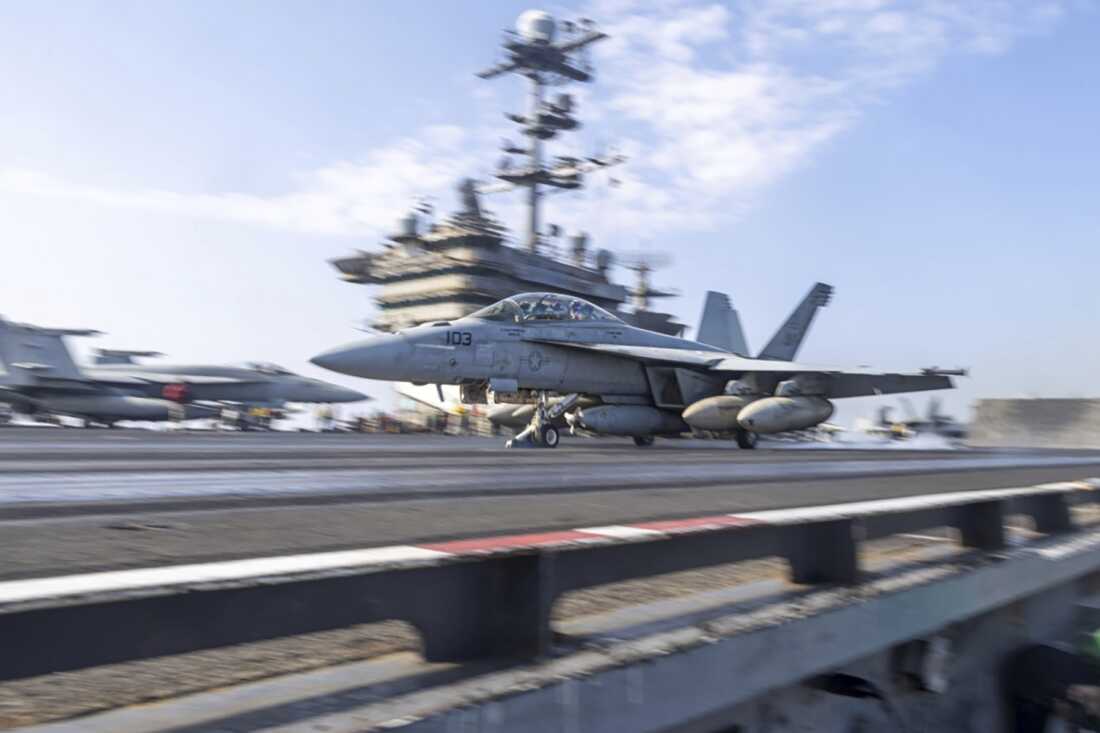
On Christmas Day, the United States military conducted a series of significant airstrikes in Nigeria, targeting what President Donald Trump described as “terrorist scum” associated with the Islamic State.
The operation represents a dramatic escalation of American military involvement in West Africa and marks a departure from the previous administration’s more cautious approach to kinetic interventions in the region.
The strikes, which took place in the early hours of December 25, reportedly focused on known insurgent strongholds in the country’s northeast, an area that has long been the epicentre of an Islamist insurgency led by Boko Haram and its more potent splinter group, the Islamic State West Africa Province (ISWAP).
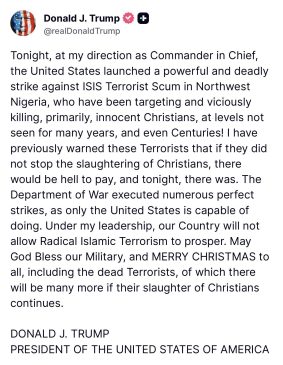
According to a statement released by the White House, the mission was authorized to eliminate high-value targets and disrupt the logistical networks of militants who pose a growing threat to regional stability and international security.
President Trump, communicating via his preferred social media platforms, hailed the mission as a “great success.” He emphasized his administration’s “zero-tolerance policy” for global terrorism, asserting that the United States would not hesitate to strike at those who threaten its interests or allies, regardless of geography.
The rhetoric used—labelling the targets “terrorist scum”—underscores the administration’s aggressive posture and its desire to project a narrative of unyielding military strength.
While the Pentagon confirmed that the strikes were precise and aimed at avoiding civilian casualties, the timing and unilateral nature of the action have sparked intense debate.
Conducting such a major military operation on Christmas Day, a sacred holiday for Nigeria’s significant Christian population, has been interpreted by some as a symbolic show of force, while others view it as a potential infringement on Nigerian sovereignty.
The humanitarian impact of the ongoing conflict in the Lake Chad Basin remains dire, with millions displaced and thousands killed over the last decade. While the US strikes may have neutralized specific tactical threats, analysts argue that military action alone cannot resolve the complex socio-economic grievances that fuel recruitment into extremist groups.
There are also concerns that such high-profile interventions could be used by insurgent groups for propaganda purposes, potentially inciting retaliatory attacks against Western interests or local Christian communities.
As the smoke clears, the long-term implications for the US-Nigeria bilateral relationship remain uncertain. While the two nations have a history of security cooperation, the Trump administration’s willingness to bypass traditional diplomatic channels in favour of direct military strikes suggests a new, more volatile chapter in West African counter-terrorism efforts.
International observers are now closely monitoring the region for any signs of escalation or shifts in the insurgent groups’ operational strategies following this Christmas Day offensive.
Confidence McHarry, a lead security analyst at SBM Intelligence, noted that the timing of the strikes on a major religious holiday carries heavy geopolitical weight.
“The decision to strike on Christmas Day is a calculated move to project dominance, but it risks playing into the hands of extremist narratives that frame Western intervention as a crusade against Islam,” McHarry said.
He further explained that such threats against Nigerian territory signify a shift where the U.S. is increasingly willing to treat the Sahel as a direct extension of its own domestic security frontier, potentially sidelining local military command structures.
Regarding the implications, McHarry warned that the unilateral nature of the action could strain the already delicate relationship between Abuja and Washington.
“By acting without a clear, public joint-command framework, the U.S. effectively signals that Nigeria’s sovereignty is secondary to American counter-terrorism objectives. This military action on such a sensitive day could lead to a ‘rally-around-the-flag’ effect among disparate insurgent groups, who may find common ground in opposing foreign intervention, thereby complicating local efforts at de-escalation.”
This intervention comes amidst a deteriorating security landscape in the Sahel, where groups linked to Al-Qaeda and the Islamic State have expanded their reach across borders.
Nigeria has struggled to contain these threats despite significant military spending, leading to increased frustration in Washington over the perceived lack of progress. The Trump administration’s move follows a series of warnings that the U.S. would take a more “hands-on” approach if regional governments could not secure their own territories.
In response to the strikes, a senior Nigerian government official, speaking on the condition of anonymity, expressed a mixture of appreciation and concern.
“While we acknowledge the support of our international partners in the fight against our common enemy, we must emphasize that any military action on Nigerian soil must respect our national sovereignty and be conducted through established bilateral channels. We are currently reviewing the details of this morning’s events to ensure the safety of our citizens remains the top priority.”


Related to this topic: