

Report: Nigeria’s military pressure is forcing armed groups to adapt, not collapse
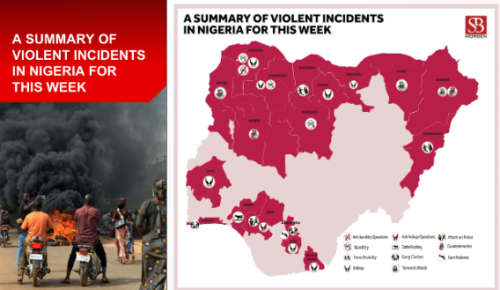
Nigeria’s recent military operations against armed groups are achieving tactical successes but are also triggering new patterns of violence that may worsen risks for civilians, according to a new security assessment by SBM Intelligence.
In its West Africa Security and Political Economy report covering December 5–11, SBM said state pressure is increasingly displacing armed groups rather than dismantling them, leading to fragmentation, rivalry, and the expansion of decentralised criminal authority across multiple regions.
The report highlights the Nigerian Army’s operation in Borgu Local Government Area of Niger State, where troops killed about 40 fighters from the Lakurawa group and forced their leader, Amir Tajudeen, to flee. While the operation represents a clear tactical win, SBM warned it also marks the start of a more dangerous phase.
“Such outcomes typically fragment, rather than neutralise, armed groups,” the report noted, adding that surviving fighters are likely to regroup across porous boundaries rather than disengage.
SBM said the 150-kilometre boundary between Niger and Kebbi states enables rapid dispersal, allowing displaced fighters to relocate into forest zones with weak security coverage. Tajudeen’s reported movement into the Ngaski forest was described as a “tactical relocation into a long-established sanctuary” offering concealment, supply routes, and access to adjoining states.
The intelligence firm warned that for communities in Ngaski, Augie and surrounding areas, the main threat is not a single retaliatory strike but a surge in predatory violence. Displaced fighters, SBM said, are likely to increase kidnappings, village raids and illegal levies to secure food, funds, weapons and recruits. This, in turn, could disrupt transport routes, inflate prices and suppress local commerce.
In the North West, SBM urged caution over military claims that operations are closing in on notorious bandit leader Bello Turji. While the killing of his lieutenant, Kallamu, in Sabon Birni was described as a significant development, SBM said experience shows that removing individual commanders rarely leads to strategic collapse.
“More often, it produces fragmented and unpredictable violence as surviving lieutenants compete for influence,” the report stated, warning that short-term disruption can give way to more erratic attacks.
The report also flagged rising internal conflicts among bandit groups. In Kebbi State, Lakurawa has fractured following the killing of senior commander Kachalla Ibn Zaidu by faction leader Dando Sibu, a dispute rooted in control of supply networks and territory. SBM warned that such infighting does not reduce violence but instead risks escalation as rival factions seek to demonstrate strength.
“ADAMAWA ACCOUNTED FOR 75% CASES OF SECURITY-FORCE BRUTALITY”
In the North East, SBM highlighted serious concerns about civilian protection and military conduct. The report cited the killing of women protesters in Adamawa State following delayed security responses to militia attacks, describing the incident as a “collapse in command discipline” and a breach of rules of engagement. SBM’s Violence Tracker data shows that Adamawa accounted for 75 percent of recorded cases of security-force brutality in the North East in 2025, pointing to systemic command failures rather than isolated misconduct.
Meanwhile, Boko Haram and Islamic State elements continue to rely heavily on improvised explosive devices, particularly in resettlement zones in Borno State. SBM reported that four children were killed by an IED in Bama, marking the tenth civilian IED incident in the LGA this year and underscoring persistent gaps in route clearance and area security.
Across southern Nigeria, the report said criminal groups are adapting to increased deployments by shifting tactics rather than retreating. In the South East, Ngor Okpala in Imo State has emerged as a major kidnapping hotspot, driven by predictable travel patterns linked to the Sam Mbakwe International Airport and dense forested escape routes. SBM warned that without layered measures such as surveillance, bush clearance and cross-border coordination, attacks are likely to persist through the festive season.
In the South West, SBM observed a shift toward home-based kidnappings, with over 70 percent of kidnapping incidents in 2025 occurring at victims’ residences rather than on highways. The trend reflects more premeditated operations based on surveillance of specific individuals and their routines.
Overall, SBM concluded that Nigeria’s security challenge is entering a more complex phase. While military pressure is forcing armed groups to relocate and reorganise, it is also intensifying competition, fragmentation and civilian exposure.
“Organised violence is being reshaped by state pressure that displaces armed groups rather than dismantling them,” the report said, warning that without sustained, coordinated and intelligence-led operations across state boundaries, civilians will continue to bear the brunt of adaptation by armed actors



Related to this topic: