

Report: Nigeria enters ‘Critical’ risk zone in new Africa Stability Index

Nigeria has been classified among Africa’s most unstable countries in a new analysis released by SBM Intelligence, which warns that economic hardship, security pressures and political fragility have pushed the country deeper into the continent’s “critical risk” bracket.
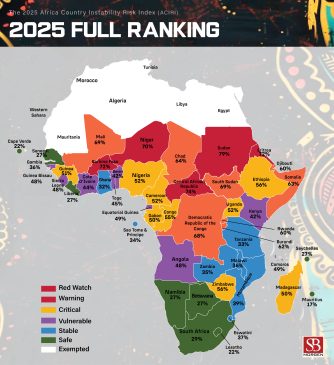
According to the 2025 Africa Country Instability Risk Index (ACIRI), published by SBM Intelligence, Nigeria recorded a score of 52, marking a significant rise from its 2024 rating and placing it firmly in the group of countries facing severe vulnerabilities.
The report explains that although official inflation appears to be easing following the GDP rebasing, the data offers little comfort to ordinary Nigerians whose purchasing power continues to erode.
SBM Intelligence notes that the removal of petrol subsidies and the impact of the exchange-rate reforms have deepened the cost-of-living crisis, triggering sharp increases in food, transport and energy prices. The report adds that more Nigerians are slipping into poverty as households struggle to adjust to rising expenses while businesses, especially small and medium-sized enterprises, shut down due to high operating costs.
The index also observes that political divisions, though less explosive than the period following the 2013 general election, remain a key source of fragility.
The report points out that persistent distrust in institutions, coupled with slow-paced reforms, continues to undermine public confidence at a time when economic pressures are intensifying. While acknowledging that institutional continuity has prevented a full collapse, the organisation warns that the underlying tensions remain unresolved.
Across the region, the report highlights that West Africa holds the largest cluster of unstable states, with Mali, Niger, Burkina Faso and Guinea recording some of the continent’s steepest risk scores. The report attributes the trend to a combination of military rule, extremist violence and weakening democratic norms that have created a volatile belt stretching across the Sahel.
On the other end of the stability spectrum, the report identifies countries such as Seychelles, Mauritius and Cape Verde as examples of resilience, citing their strong institutions, stable governance and tourism-driven economies. Botswana and Namibia also appear in the more stable category, even though both economies are adjusting to global commodity shifts.
For Nigeria, the report concludes that while reforms such as fiscal tightening and renewed engagement with investors signal a willingness to steady the economy, these efforts will remain fragile unless the government prioritises policies that ease the financial pressure on citizens. The report warns that without visible relief, Nigeria’s position in the “critical” bracket may persist throughout 2025.


Closing in on Tinubu’s 15% inflation goal

Related to this topic: