
FCT Area Council Polls: PDP, APC’s Long Dominance Under Threat

The Federal Capital Territory (FCT) Area Council election is hours away and a number of factors, including political meddling, incumbency advantage, party strength, candidate popularity, voter turnout, election security, vote buying, and the credibility of the Independent National Electoral Commission (INEC), could determine who wins the chairmanship seats in the FCT’s six area councils on February 21, 2026.
A total of 570 candidates are running for various positions, and the Independent National Electoral Commission (INEC) estimates that over 1.6 million registered voters will cast ballots at 2,822 polling stations throughout the FCT to elect six chairmen and 62 council members.
According to the Independent National Electoral Commission (INEC), more than 1.6 million registered voters are expected to vote at 2,822 polling stations across the FCT to elect six chairmen and 62 councillors, with a total of 570 candidates running for various positions.
History of the Election
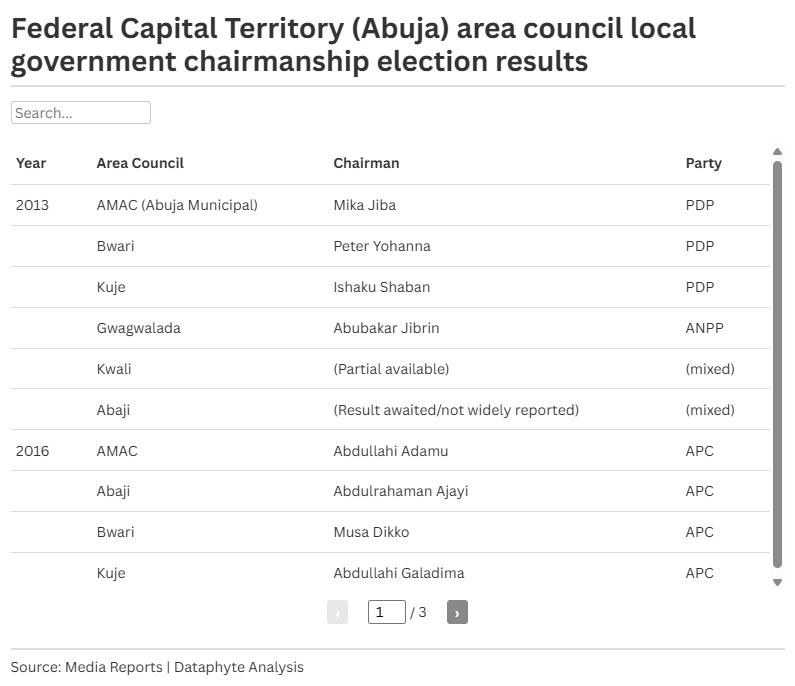
The Federal Capital Territory’s six area councils held four election cycles between 2013 and 2022. The PDP and APC dominated the chairmanships, while the All Nigeria Peoples Party (ANPP) and the All Progressives Grand Alliance (APGA) each took home one seat in 2013 and 2016.
Kuje, the Abuja Municipal Area Council (AMAC), Bwari, and Kwali were the four designated area councils that the PDP won in 2013. Although the results in the Abaji Council could not yet be verified, the ANPP had won the Gwagwalada Council.
The political scene changed by 2016. Five of the six area councils—AMAC, Abaji, Bwari, Kuje, and Kwali—were won by the APC. However, the Gwagwalada Council seat was won by the APGA.
In 2019, the PDP took over Kuje, while the APC held onto power in AMAC, Gwagwalada, and Kwali. The outcome was uncertain at the time of reporting since Wesley Nafarda, the returning officer, ruled the Bwari election inconclusive due to issues in certain voting stations.
The six chairmanship seats will be split evenly between the APC and PDP by 2022, with the APC gaining Gwagwalada, Kwali, and Abaji and the PDP gaining AMAC, Bwari, and Kuje.
The outcome of tomorrow’s area council election will once again demonstrate how political dynamics are changing across the six area councils in the Federal Capital Territory.



Related to this topic:

Sponsors of Kalu’s Certificate Allegations Under Fire