
Edo Govt, PDP in war of words over how Obaseki allegedly secured N25bn bond to fund hotel
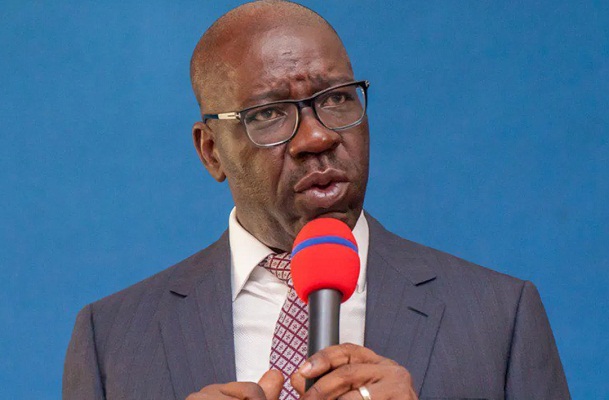
Edo state government has opened its audited records around how money was channeled towards a controversial project executed by ex-governor ,Godwin Obaseki, saying he took the sum of N25 billion bond to finance the hotel he later allegedly sold to one of his cronies for peanut.
This revelations was contained in a video posted by the state commissioner for Information and Strategy, Prince Kassim Afegbua while dismissing Obaseki’s claim that Edo state government only spent N2 billion on Radisson hotel.
Obaseki had reportedly claimed that Edo State invested only ₦2 billion in purchasing the Radisson Hotel from Chief Gabriel Igbinedion, the Esama of Benin.However, Afegbua has countered the claim, stating that documents before him show consistent payments to Radisson from 2022 till date from government records.
He further argued that Edo State sourced ₦25 billion from the stock market, a sum that remains a debt burden on Edo taxpayers. Every month since the new administration assumed office, ₦385 million is deducted from the state’s internally generated revenue through an Irrevocable Standing Payment Order (ISPO) to service this debt.
According to Afegbua, it is true that ₦2 billion was paid to purchase the land complete with payment vouchers, dates, accounts, and beneficiaries. But that was only a fraction of the spending. He noted that additional payments were made to consultants, to Afrinvest (Obaseki’s company) for advisory services, and to Banwo & Ighodalo for legal advisory.
His words, “From the bond proceeds, the state also paid W Hospitality Group in eight tranches, all made almost on the same day, amounting to ₦24 million. Another payment of ₦1.589 billion was made to Mar & More Integrated Services for the supply and installation of mechanical works. Further payments were again made to Afrinvest, and more than ₦900 million was paid to the contractor handling the hotel project; also from the bond.
“Altogether, ₦16 billion was paid out of the bond proceeds, while ₦2.677 billion was spent directly from government accounts, as of May 2024.
He insisted that Obaseki’s company, Afrinvest, served as the financial adviser on the Radisson project and was receiving payments at multiple points.
“We speak with facts and figures,” he said. “All the lies told by Obaseki have now been exposed.As of today, Edo State continues to pay ₦385 million monthly to service the ₦25 billion bond.”
Afegbua added, the contractor demanded a variation of about ₦6 billion, barely six months after receiving the contract.
According to the commissioner for Information,” Obaseki claimed he sold the Radisson Hotel to a company called T-Bree Group, owned by one of his associates. But investigations revealed that T-Bree Group was registered in May 2024, just five months before Obaseki left office.
He said Corporate Affairs Commission (CAC) records reportedly listed the man, his wife, and daughter as directors. The company had no business track record, as this was its first registration. Yet, according to Obaseki, the state had to “beg” the company to give Edo State 20% ownership, despite the state having spent over ₦20 billion on the project.
“Obaseki prides himself as a financial expert and investment banker but I call this voodoo financing, the work of a man who never meant well for the people.The Radisson Hotel in Edo State belongs to Edo people. It was initiated, built, and funded with Edo taxpayers’ money. It is, and remains, Edo Radisson Hotel,”Afegbua posited.
Responding,the opposition People’s Democratic Party (PDP) in the state has described Afegbua’s revelation as APC’s illiterate propaganda.According to a terse Press statement signed by the Party’s State Publicity Secretary,Barr.Dan Osa-Ogbegie,” we would ordinarily have ignored the latest illiterate outburst credited to Kassim Afegbua, the Edo State Commissioner for Information and Strategy, particularly as the subject matter is already under litigation before competent courts of law. However, for the sake of the unsuspecting general public, and to prevent the APC and their Edo masters of propaganda and disinformation from having a field day spreading calculated falsehoods, half-truths and deliberate mischief, we are compelled to respond.
” This administration’s obsession with Obaseki is now pathological. Since assuming office, the Okpebholo government has operated in blind rage, determined to dismantle and demonise Obaseki’s legacy projects, not because they failed, but precisely because they succeeded and set standards this government neither understands nor can replicate.
” We have watched the reckless onslaught against the Museum of West African Art project. We have seen the hostility directed at the 95MW Ossiomo Power Project. We witnessed the harassment of Saro Farms and the ethanol investment in Ikpoba Okha. We observed the deliberate crippling of the Edo Printing Press at the Nigerian Observer premises. We saw the embarrassing misadventure against Presco Plc, from which the government retreated only after public outrage and investor backlash. Now, the Radisson Hotel project has become the latest victim of this administration’s politics of destruction.
” For the avoidance of doubt, the Radisson Hotel project was structured as a Public-Private Partnership. Edo State’s ₦2 billion contribution was seed equity injected to de-risk the project and attract credible private capital. The core private investor brought in substantial equity of its own. Other funds referenced by the government, including portions of bond proceeds, were deployed as loans to the Special Purpose Vehicle for construction and completion of the hotel, with clear repayment obligations tied to future operations. This is not plunder. This is development finance.
” Even before commencement of operations, the Edo investment in the Radisson project had already appreciated significantly, conservatively valued at over ₦65 billion, with further upside expected once operations begin. This is what happens when governments think strategically, attract private capital and invest in long-term economic assets”, Osa-Ogbegie explained.


Related to this topic:

Tinubu Approves ₦712bn Overhaul of Lagos Airport