
Countries Backing Trump’s ‘Board of Peace’ for Gaza Face US Immigrant Visa Bans
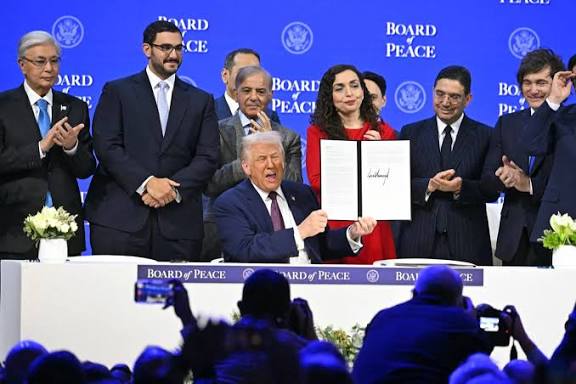
Several countries backing President Donald Trump’s proposed “Board of Peace” to stabilise Gaza are also facing restrictions on immigrant visa processing by the US State Department.
Trump signed the charter establishing the body — which is intended to help resolve international conflicts — on the sidelines of the World Economic Forum in Davos, Switzerland. He described the board as potentially “one of the most consequential bodies ever created”.
Nineteen countries, largely from the Middle East, Asia and South America, joined the US president on stage during the signing ceremony. They included representatives from Kazakhstan, Kosovo, Pakistan, Paraguay, Qatar, Bahrain, Egypt, Turkey, the United Arab Emirates, Saudi Arabia, Uzbekistan, Mongolia, Jordan, Argentina, Armenia, Morocco, Azerbaijan, Bulgaria and Hungary.
Israel, Albania, Vietnam, Indonesia and Belarus also agreed to join the board but were absent from the ceremony.
However, some member countries of the board face travel restrictions to the United States. Albania, Armenia, Azerbaijan, Belarus, Egypt, Jordan, Kazakhstan, Kosovo, Morocco, Mongolia, Pakistan and Uzbekistan are among 75 countries the Trump administration has classified as likely to require public assistance while living in the US.
Earlier this year, Secretary of State Marco Rubio instructed consular officers to halt immigrant visa applications from these countries.
“President Trump has made clear that immigrants must be financially self-sufficient and not be a financial burden to Americans,” the State Department said in a statement released last week.
“The Department of State is undergoing a full review of all policies, regulations, and guidance to ensure that immigrants from these high-risk countries do not utilise welfare in the United States or become a public charge,” it added.
Despite the visa restrictions, the 12 affected countries continue to support Trump’s Middle East initiative, even as the proposal faces strong resistance from leaders within the European Union.
Critics have warned that the Board of Peace could undermine the functions of the United Nations, raising concerns among prospective members. Others have criticised the reported $1 billion cost of securing a permanent seat on the board.